
EDL Riot in Bradford
Abandoned Homes and Religious Signs Remember Hurricane Katrina on Fifth Anniversary
Pumpjack Gas Wells and Refineries in Louisiana
Exxon, Valdez, BP and Deepwater Horizon: Dr. Riki Ott
>Stills, video, print (c) Jason N. Parkinson 2010. All Rights Reserved.

Marine Toxicologist and Exxon Valdez survivor Dr. Riki Ott, PhD, talks about her experiences from the Valdez oil disaster and uncovers the BP cover-up in the Gulf of Mexico.
Dr. Riki Ott blog here.
(c) Jason N. Parkinson 2010. All Rights Reserved.
Please contact the AUTHOR for access to any material and the extensive five-year video archive.
BP – Gulf of Mexico: Catalogue of Destruction


Sunday 16 August 2010: Local people on Pensacola Beach, Florida, spoke of the oil slicks and tar balls that were never removed, meerly covered over with sand by BP clean-up workers at night. These images were captured the day after President Obama stood in Pensacola, declared the beach “open for business” and took his family swimming.

Monday 16 August 2010: A dying catfish, one of several, in a tidal lagoon on Dauphin Island beach, near Mobile, Alabama, appeared to be suffering from burns to its head and body.

Tuesday 17 August 2010: Following the return of tropical depression number five an oil clean-up boom lay strewn across Pass Christian beach, Mississipi, the beach showing signs of oil staining, prompting the question who is going to clean up after the clean up?

The coastline from Biloxi to Pass Christian, Mississipi, was littered with these brown jellyfish. The trouble is, according to locals, these jellyfish should be clear with pink, purple or blue internal organs and are often luminous – they don’t come in brown.


By Tuesday evening, following several storms that swept in off the Gulf of Mexico, the coastline from Pass Christian to Biloxi in Mississippi was covered in a white and brown mousse-like foam, suspected of being a mixture of Corexit and dispersed oil. Experts claim the combined chemicals are more toxic than oil or dispersant alone. After spending several hours documenting this mousse, our team suffered the following health effects – skin irritation, sore throat, headaches, stomach pains and diarrhoea.

The BP clean-up teams along this 25 mile stretch of white sandy coastline massed to groups of twos and threes, with shovels and buckets, wellington boots and rubber gloves and not much else. In all there were approximately five teams, several larger with an occasional sand skimming machine.
The full photogallery by Jess Hurd here.
(c) Jason N. Parkinson 2010. All Rights Reserved.
Please contact the AUTHOR for access to any material and the extensive five-year video archive.
BP – Gulf of Mexico: Move Along, There’s Nothing to See Here
Stills, video, print (c) Jason N. Parkinson 2010. All Rights Reserved.

Pelicans take flight from oil booms off Grand Isle coast, Louisiana
If you ask anyone from BP, or from the various authorities along the US Gulf coast enacted to tackle the oil disaster, the reply you will get is everything is fine. Move along, nothing to see here. The oil has gone and the sea is fine. And stop photographing those dead fish.
Now, if you ask anyone else, anyone, the reply you will get is we are being lied to. They [BP] sunk the oil, killing the bottom of the food chain and the dispersants and fumes from burned oil are slowly killing everything else. That has been the response from everyone one I have met, from bar staff to boat people, to tourists who come to look one last time at the Gulf before it is totally destroyed.
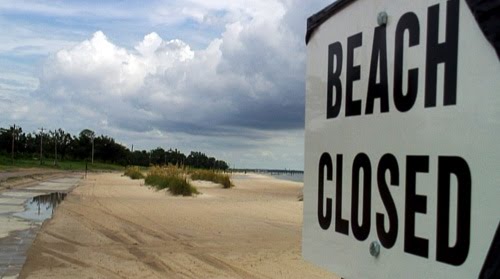
Beach closed sign at Bay St. Louis, Mississippi
As BP scales back the clean-up operation, declaring most of the oil has gone – sunk, skimmed, burned or evaporated – more and more people are turning up sick. The US news outlets are reporting that some of the clean-up workers (as many as 300 at this point) are suffering symptoms – those symptoms include sore throats, coughs, headaches, blocked sinuses, burning eyes, bleeding ears, rashes, blisters, welts and disruption to the nervous system and respiratory system. One fisherman described how since being heavily exposed to the dispersant they had an increased irritability on top of losing a majority of their lung capacity.
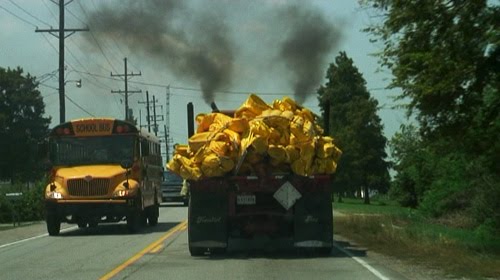
A truck returns oil booms inland after BP downsize the clean-up
But it is not just the clean-up crews, ordinary members of the public across the four Gulf States are getting sick, some of them having no contact with Gulf water. Even as far inland as New Orleans people have recounted in recent days how the smell of oil was thick in the air. And with it came the headaches and sore throats.

A tropical storm hits land near Biloxi, Mississippi
If fear of the fish, the sea and the air was not enough, people also fear the rain and what it contains. This is bad, as hurricane season has just started and torrential downpours, tropical storms and worse are commonplace along the Gulf coast, an addition and unwanted concern for those about to remember Katrina five years on.
(c) Jason N. Parkinson 2010. All Rights Reserved.
Please contact the AUTHOR for access to any material and the extensive five-year video archive.